

































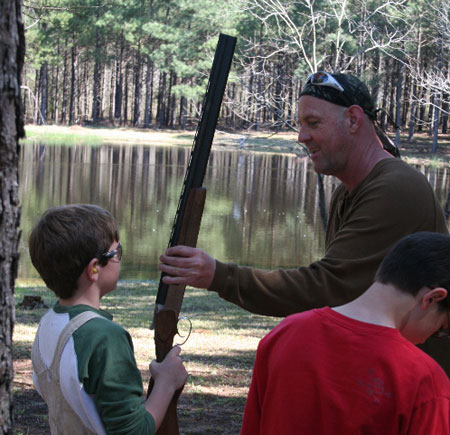
“I pledge my head to clearer thinking, my heart to greater loyalty, my hands to larger service and my health to better living for my club, my community, my country and my world.” These words can be heard from the mouths of millions of young 4-H members across our nation. What started in the early 1900s to educate the young children of rural farmers has now grown into one of the country’s largest extracurricular youth programs. 4-H is not absent in Monticello. In fact, one of the fastest growing features of our local 4-H is the shooting sports program, and this group is mainly organized by Terry Koone. This is his story:
Terry Koone grew up in Conway, Arkansas. His dad worked for Southwestern Bell and his mom was a Farmers Home Administrator. He was the second oldest of four boys in his family. He grew up hunting, fishing and camping. All of these were a family affair and happened almost every weekend. He attended UCA and received a degree in business. He has worked for Farm Bureau as a claims adjuster most of his life.
In 1981 he married Jackie who was from Vilonia. That same year they moved to Monticello and made it their home. Terry and Jackie have two children, Kristen, 21 and Steven, 16. Terry became involved in 4-H for them. When his daughter was nine, she joined the organization. She was involved in several aspects of the club. She won state competitions in cooking. In photography she once was featured in the national 4-H calendar. Although Terry was not a part of 4-H when he grew up, he loved that his kids were a part of a group that had a “hands-on” philosophy. He loved to see them “grow and excel.”
His son, Steven, received a bow for Christmas at age 12. Terry didn’t bow-shoot and found the Drew County Bow Club ready and willing to help him and his son with their new hobby. At that time, Terry realized that 4-H had a shooting sports program on a national level but not in Monticello . He made a decision then to help begin one for the Drew County 4-H.
This is now the sixth year for the 4-H shooting sports program. The first year there were two students. In the third year, they had 8 students but no full teams to compete on a state level. In 2005, they had enough students to compete on a state level. They had a Junior Team (ages 9-13) and a Senior Team (ages 14-19). That year the Junior Team brought home 34 trophies and received a total of 60 ribbons. Last year they raised the bar and brought home 86 ribbons. The group is excited about the possibilities this year now that it has grown to over 40 students.
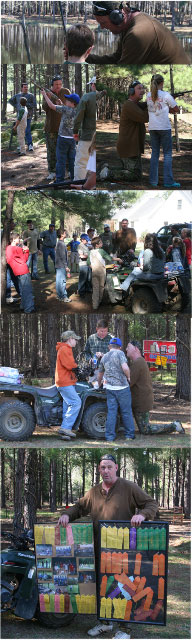 The 4-H Shooting Sports Progam has been a “blessing” for Terry. He does not get paid financially for his involvement or time but says that watching the kids grow and learn is payment enough for him. Terry is passionate about the organization and what it teaches the kids.
Although there are no gun clubs in Drew County, and there are no gun ranges around for the kids to practice, it didn’t stop Terry from making this possible for the kids of the shooting club.The 4-H shooting club started and still meets in Terry’s 20-acre backyard. He uses old signs from around town for targets, and there is always a firearm for someone to use. When the program started they had no equipment. Terry has used his own money at times to see that the needs are met. He has also involved as many people and parents as he can to see the program succeed. The Drew County Bow Club lets the 4-H club run a concession stand for their invitationals and have also given several bows to the 4-H group. The Friends of the NRA has a grant program that the Drew County 4-H applies for each year, and the 4-H students sell raffle tickets for the Friends of the NRA which allows the 4-H to receive some of the proceeds and/or equipment. Terry has seen the program grow by leaps and bounds and says it is “the best kept secret in the state of Arkansas.”
This program is not just about kids and firearms. The 4-H Shooting Sports Program has 4 disciplines: shotgun, .22, black-powder and archery. Terry has completed the instructional programs to train in these areas both on the state and national levels. The participants not only shoot targets, but they also learn the importance of safety, competition, life skills and practice. 4-H is open to all students ages 9-19, and there are many different 4-H programs here in Drew County. For about 40 shooting-sport students who meet twice a month in Rock Springs, the lessons they learn and fun they have make them thankful for Terry’s dedication and vision. He is a great example of the 4-H pledge. His heart has helped many young Monticellonians. Thank you, Terry Koone – one Monticello life.

 At the end of the internship she was voted on by her peers and manager for the
  This past week at the
  In looking toward the future, she mentioned that the church is starting a new building project.
 Priscilla Hopkins Houdlette Smith was born in Boston, Massachusetts in 1918. Her father was a civil engineer who designed the majority of interstate highways in that state. Her mother was a house wife who died during the birth of Priscilla’s sister, Claire. Priscilla was seven years old at the time. She and her sister were raised by their grandmother for most of their lives.
 "When I met Smitty, he was changing his son’s diaper. I knew then he needed a mother for his kids," Priscilla smiled.
 As she received her personal tour of South Arkansas Rehabilitation this past week, she was wheeled into the children’s room that has been dedicated to her. On the wall there is a picture of Priscilla working with a child who was a polio victim. The words below the photo say "In appreciation of your contribution to the physical therapy profession and the many patients you served, and for the inspiration you have provided those of us who have followed in your footsteps… Thank you! We love you! Your friends at South Arkansas Rehabilitation." Priscilla Smith will never be able to estimate the lives she’s literally touched over the years. Our community is grateful for such a life: One Monticello Life.
 Her freshman year she married a schoolmate, Tommy Simpson. After her first year in college, they moved to South Carolina for two years where Tommy served in the Air Force. In 1970, the couple moved back to Monticello and had their first child.
 Unwilling to simply go to work and return home, Mae is currently on a committee to restore her old school house in Selma. She and several others are worked towards making Selma Junior High School a historical site. The building is used now for banquets and group meetings like the Masons and Eastern Star organization of which Mae is a member. Mae is also an active member of 16th Section Missionary Baptist Church.
  "High school was a tough period for me and my family," Rob said. "Basically everything I ever believed was called into question. I went from the kid whose dad preached at the biggest church in town to the kid who didn’t really have a church anymore. I didn’t know what was going on."
 When asked why he and the MBSF spend so much time trying to reach students, Rob responded, "Because Jesus changes lives."
 This is how you would describe Ruth & Ruby Brown. You might have seen these identical twins around town on Fridays. This is their day to eat lunch at a local restaurant. And most days, they wear the same color. This is by coincidence usually. Not only are Ruby and Ruth twins, they also married brothers! Here is their story: Ruby and Ruth Barrett Brown were born in 1930. They were raised in Warren. Their father was a farmer, and they have two brothers and two sisters. Their father died when they were young. Their mother raised the six children with the help of their grandparents who also farmed. The Brown brothers moved from Cleveland County to Bradley County in 1945. The Browns also farmed. There were five children in their family, four boys and 1 girl. It was at Macedonia Baptist Church that T.H. and Larkin Brown met the twins. "We were at church, and there they were, sitting on the pew," Larkin recalls about the first time he met Ruby and Ruth. "Back in those days, we didn’t date until you were 16. Me and Ruth were 15 at the time." Ruby also said they were all friends until they could start dating. "We rode to school in a taxi. So we went to school together before we dated," she said. Both T.H. and Larkin served in the U.S. Military. T.H. served in China during World War II. Larkin served during the Korean War. But war did not keep these brothers and twins apart for long. After T.H. returned from the war, he finished high school. In 1948, Ruth and T.H. married. One week after Larkin came home from Korea in 1952, Ruby and Larkin were married. Each couple moved frequently, for the mens’ jobs. T.H. attended Chicago Electrical School and worked for Entergy for 42 years. Larkin attended
  T.H. and Larkin were asked what it was like being married to twins. Larkin said it was "great," because "If I want to go somewhere, all I have to say is, ‘Ruth called,’ and she’d go over there. Then I can go and do what I want to," he said with a grin. T.H. said, "I haven’t been married to anybody else, so I don’t know. All I can say is I got the best looking of the bunch!" Larkin is quick to respond, "That’s the only one that would have you!" Ruby and Ruth drink coffee together every morning. The twins do not do much without the other. They all attend
  Mr. Carpenter was on his way to the car wash so he could look for change. He said, “If I had not got beat up or ran over, I would worked at Wal-Mart 14 years today and could have retired 3 years ago.”